Tech & Innovation
Will AI Replace Websites?
Artificial intelligence is transforming how people search for information, but technology experts say websites remain the foundation of the modern internet. As businesses adopt AI and expand their digital presence, owning a secure, authoritative website is becoming more important—not less—for building trust, managing customer relationships and maintaining long-term control over digital assets.

Published
4 months agoon
Are Websites Still Relevant in the Age of AI? Why Businesses Continue to Invest in Their Digital Presence
Every few years, predictions emerge that websites are becoming obsolete.
When social media platforms grew rapidly in the late 2000s, many believed company websites would become unnecessary. Later, the rise of mobile applications led some commentators to suggest that apps would replace traditional websites altogether.
Today, artificial intelligence has sparked a similar debate.
AI assistants can answer questions, summarise documents and recommend products without always directing users to a webpage. As a result, some business owners are asking whether websites still matter in an era increasingly shaped by conversational AI.
Technology analysts say the answer is yes—but the role of websites is evolving rather than disappearing.
Websites Remain the Internet’s Primary Source of Information
Although AI is changing how people discover information, most large language models and search engines still rely on information originally published by organisations, governments, universities, businesses and publishers on the web.
Google, Microsoft and OpenAI have all emphasised the importance of high-quality web content in supporting modern AI systems.
Without websites producing original information, there would be significantly less reliable material available for search engines and AI assistants to analyse.
Rather than replacing websites, artificial intelligence is increasing the importance of authoritative online content.
Why Businesses Still Need Their Own Website
Social media has become an essential communication channel for many organisations.
However, digital marketing specialists frequently distinguish between owned media and rented media.
A company’s website is considered owned media because the organisation controls its content, branding, customer experience and data collection.
Social media platforms, by contrast, operate according to algorithms and policies determined by third-party companies. Changes to those systems can significantly affect how businesses reach their audiences.
Marketing researchers therefore generally recommend using social media to complement—not replace—a company’s own website.
Trust Often Begins With an Official Website
Consumer behaviour studies consistently show that people often visit an organisation’s official website before making important purchasing decisions.
Potential customers typically expect to find detailed information about products and services, pricing, contact details, privacy policies, support resources and company credentials.
For regulated industries such as banking, healthcare, education and legal services, official websites also play an important role in demonstrating transparency and regulatory compliance.
While social media profiles help increase visibility, websites generally remain the primary source of verified business information.
Artificial Intelligence Is Changing Search Behaviour
Search engines themselves are evolving.
Google’s AI-generated search summaries and Microsoft’s AI-powered search experiences increasingly provide users with direct answers before they click on individual websites.
This has led some publishers to worry that website traffic could decline.
Industry analysts argue, however, that the businesses most likely to succeed will be those producing original, authoritative content that AI systems consider trustworthy enough to reference.
Instead of competing with AI, websites are becoming part of the information ecosystem that AI relies upon.
The Rise of the Digital Headquarters
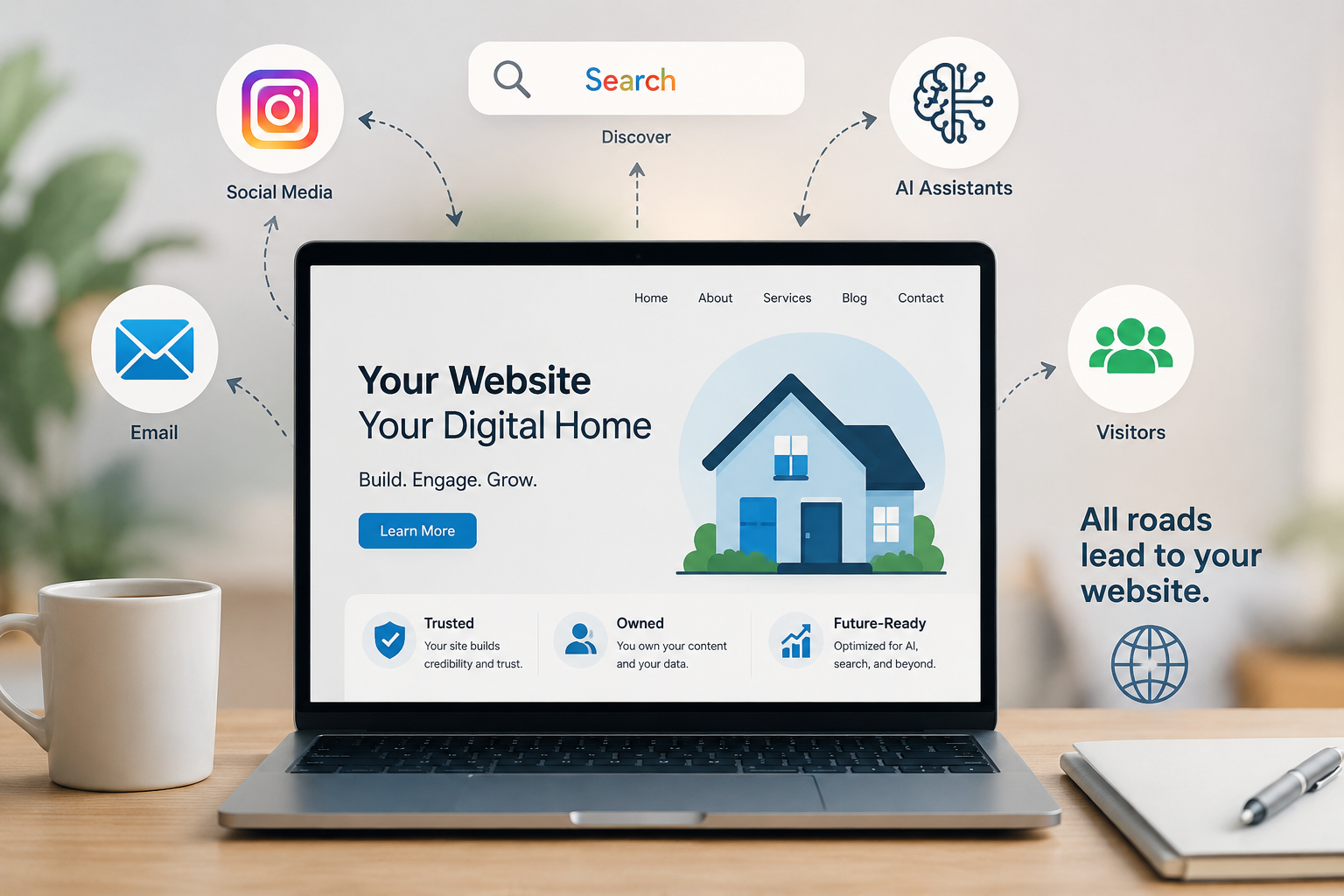
Technology strategists increasingly describe websites as a business’s digital headquarters.
Social media platforms introduce customers to a brand.
Search engines help users discover information.
Email marketing strengthens ongoing relationships.
Artificial intelligence assists with customer support and personalised recommendations.
Yet websites remain the central location where organisations publish official information, complete transactions and manage long-term customer relationships.
Rather than replacing one another, these channels perform complementary roles within a broader digital strategy.
How Websites Are Evolving
Modern websites increasingly incorporate technologies that were uncommon only a few years ago.
Artificial intelligence now assists with customer service through chatbots, personalises content recommendations and improves accessibility by supporting voice interaction and language translation.
At the same time, faster internet connections, cloud computing and modern development frameworks have enabled websites to become more interactive, secure and responsive across a growing range of devices.
Industry experts expect this evolution to continue as AI capabilities become more deeply integrated into everyday online experiences.
The Importance of Digital Ownership
One of the strongest arguments for maintaining a website concerns long-term control.
Businesses that rely exclusively on third-party platforms remain vulnerable to changing algorithms, pricing models or platform policies.
Owning a website provides greater independence over branding, customer relationships and digital assets.
It also allows organisations to integrate multiple channels—including search engines, social media, email marketing and AI-powered services—within a single online presence.
Looking Ahead
The question facing businesses is no longer whether websites or artificial intelligence will dominate the future of the internet.
Instead, it is how the two technologies will work together.
Artificial intelligence is transforming how information is discovered, but websites continue to provide the original content, trusted identity and digital infrastructure upon which much of the modern internet depends.
As organisations continue adopting AI, the value of maintaining a fast, secure and authoritative website is likely to increase rather than diminish.
Far from becoming obsolete, websites appear to be entering a new phase—one in which they function not simply as online brochures, but as the trusted foundation connecting search, artificial intelligence, digital commerce and customer relationships.

You may like


How Netflix Changed the Way the World Watches Entertainment
-
Is Computer Science Still Worth Studying in the Age of AI?
-
Artificial Intelligence in Africa: Can Emerging Technology Help Solve the Continent’s Biggest Challenges?
-
Why Home Servers Are Making a Comeback in the Cloud Era
-
Africa’s Digital Transformation: How Technology Is Reshaping the Continent