Politics & Power
ECOWAS at 50: Can West Africa’s Most Ambitious Regional Project Survive a New Era of Division?
“Perhaps no other African regional organization has demonstrated such willingness to intervene directly during political crises.”

Published
4 months agoon
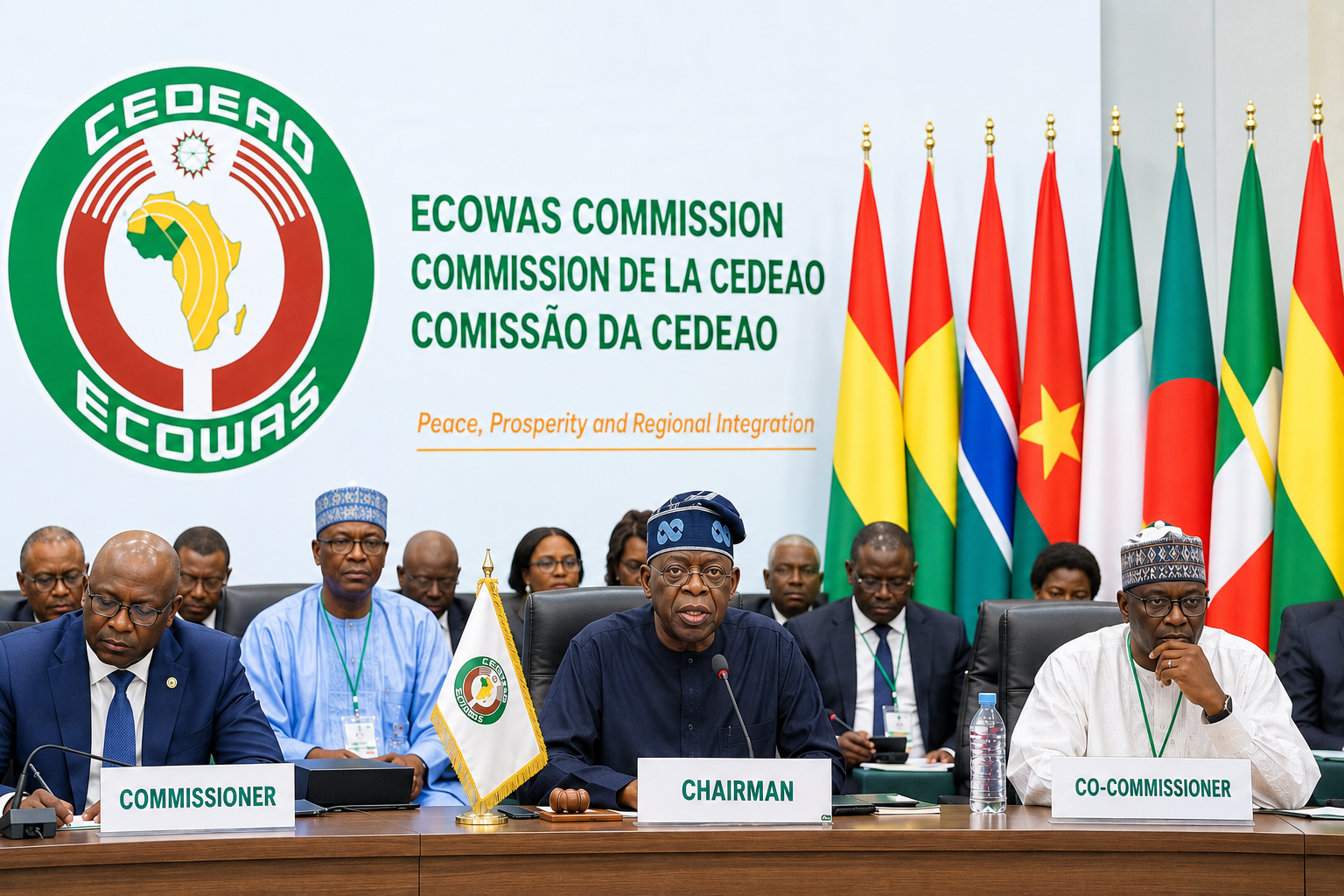
When the leaders of fifteen West African nations signed the Treaty of Lagos on 28 May 1975, they were attempting something few regions of the developing world had achieved.
Their ambition was not simply to create another international organisation. They wanted to dismantle the economic barriers left by colonial rule, encourage trade between neighbouring countries and build a regional economy capable of competing on the global stage.
Half a century later, the Economic Community of West African States (ECOWAS) has become far more than its founders imagined. It has negotiated peace agreements, deployed military forces, defended democratic transitions and created one of Africa’s most advanced free-movement systems.
Yet as the organisation marks its fiftieth anniversary, it faces perhaps the greatest test in its history.
Military coups, violent extremism across the Sahel, economic uncertainty and the withdrawal of Mali, Burkina Faso and Niger have raised difficult questions about whether West Africa’s most influential regional bloc can remain united in an increasingly fragmented political landscape.
A Vision Born From Shared Challenges
The idea behind ECOWAS emerged from a simple economic reality.
Although West African countries achieved political independence during the 1950s and 1960s, their economies remained largely disconnected from one another. Colonial infrastructure had been designed to move raw materials such as cocoa, gold, timber and cotton to European ports rather than linking neighbouring African markets.
As a result, countries often traded more easily with Europe than with the nation across their own border.
Regional leaders, inspired by Pan-African ideals championed by figures including Kwame Nkrumah, increasingly argued that genuine independence required economic integration as well as political sovereignty.
That vision found its strongest advocates in Nigerian Head of State General Yakubu Gowon and Togolese President Gnassingbé Eyadéma, whose diplomatic efforts culminated in the signing of the Treaty of Lagos in 1975.
From Trade to Security
ECOWAS was originally established to reduce tariffs, improve transport links and encourage investment across West Africa.
Its founders believed that a larger regional market would stimulate industrialisation, attract foreign investment and strengthen the region’s bargaining power in the global economy.
However, events soon demonstrated that economic integration could not succeed without political stability.
Civil wars in Liberia, Sierra Leone and Guinea-Bissau during the 1990s transformed the organisation’s priorities.
Rather than limiting itself to trade policy, ECOWAS gradually evolved into one of Africa’s most active regional security organisations. The adoption of the Revised ECOWAS Treaty in 1993 expanded its mandate to include conflict prevention, peacekeeping, democracy and human rights.
Political scientists frequently cite this evolution as one of ECOWAS’s defining characteristics, distinguishing it from many regional economic organisations elsewhere in the world.
The Organisation That Was Prepared to Intervene
Perhaps ECOWAS’s most distinctive feature has been its willingness to act during political crises.
Through the ECOWAS Monitoring Group (ECOMOG), regional troops intervened in Liberia, Sierra Leone and Guinea-Bissau at times when state institutions had largely collapsed.
While these operations attracted criticism over their cost, effectiveness and legal basis, many scholars argue they helped prevent conflicts from spreading across neighbouring countries.
More recently, the organisation demonstrated its political influence during The Gambia’s 2017 constitutional crisis. After President Yahya Jammeh refused to accept electoral defeat, ECOWAS combined diplomatic pressure with the credible threat of military intervention. Jammeh eventually stepped aside, allowing President Adama Barrow to assume office peacefully.
For supporters, the episode reinforced ECOWAS’s reputation as one of Africa’s strongest defenders of constitutional government.
Quiet Successes Often Receive Less Attention
Although military interventions dominate international headlines, many analysts argue that ECOWAS’s greatest achievements have been economic and social.
Its Protocol on Free Movement of Persons, Residence and Establishment has enabled millions of West Africans to travel across member states without visas for short visits.
Cross-border traders, transport operators, students and professionals have benefited from easier movement, strengthening commercial and cultural ties throughout the region.
The African Development Bank has described regional integration as essential to expanding intra-African trade, reducing business costs and encouraging long-term investment.
Even so, implementation remains uneven. Border delays, inconsistent customs procedures and infrastructure gaps continue limiting the full potential of regional commerce.
The Eco: An Ambition Still Waiting
Among ECOWAS’s longest-running projects is the proposed Eco, a single regional currency intended to simplify trade and deepen economic integration.
Economists argue that a common currency could reduce exchange-rate costs and strengthen regional markets.
However, introducing such a currency requires participating countries to maintain similar levels of inflation, debt, fiscal discipline and monetary stability—conditions that have proved difficult to achieve across economies with different structures and policy priorities.
As a result, the Eco remains an aspiration rather than a functioning currency.
A Region Facing New Pressures
The organisation’s current challenges extend well beyond economics.
Violence linked to extremist groups has intensified across the Sahel, while a succession of military coups in Mali, Burkina Faso and Niger fundamentally altered regional politics.
ECOWAS responded by demanding constitutional transitions and imposing sanctions on several military governments. Those governments, however, argued that the measures undermined national sovereignty and failed to address worsening security threats.
The disagreement ultimately led to one of the most significant moments in ECOWAS’s history.
In January 2025, Mali, Burkina Faso and Niger formally withdrew from the organisation and strengthened their cooperation through the Alliance of Sahel States (AES).
The departure marked the first coordinated withdrawal of multiple member states since ECOWAS was founded.
Nigeria’s Influence—and Its Challenge
No assessment of ECOWAS can ignore Nigeria.
Home to more than half of the bloc’s population and its largest economy, Nigeria has long been the organisation’s principal financial contributor and diplomatic heavyweight.
Successive Nigerian governments have played leading roles in peacekeeping operations, mediation efforts and institutional development.
Yet Nigeria’s influence has also generated debate.
Some observers argue that strong leadership has enabled ECOWAS to act decisively during crises. Others believe smaller member states sometimes worry that regional priorities reflect Nigerian interests more than collective consensus.
Managing that balance remains one of the organisation’s most delicate political responsibilities.
Can ECOWAS Reinvent Itself?
Fifty years after its creation, ECOWAS remains one of Africa’s most influential regional institutions.
It continues facilitating trade, promoting democratic governance, supporting infrastructure development and encouraging the free movement of millions of West Africans.
At the same time, its future will depend on its ability to adapt to changing political realities.
The organisation now faces challenges that its founders could scarcely have imagined: violent extremism, climate-related pressures, digital transformation, geopolitical competition and growing public expectations for economic opportunity.
Whether ECOWAS emerges stronger from this period will depend not only on restoring political trust among governments but also on demonstrating to ordinary citizens that regional integration continues to improve everyday lives.
Half a century after the Treaty of Lagos, the original vision remains remarkably relevant. A more connected, peaceful and prosperous West Africa is still an aspiration shared by millions across the region.
The question facing ECOWAS today is not whether regional cooperation remains necessary.
It is whether the organisation can evolve quickly enough to lead West Africa through its next fifty years.